Introduction
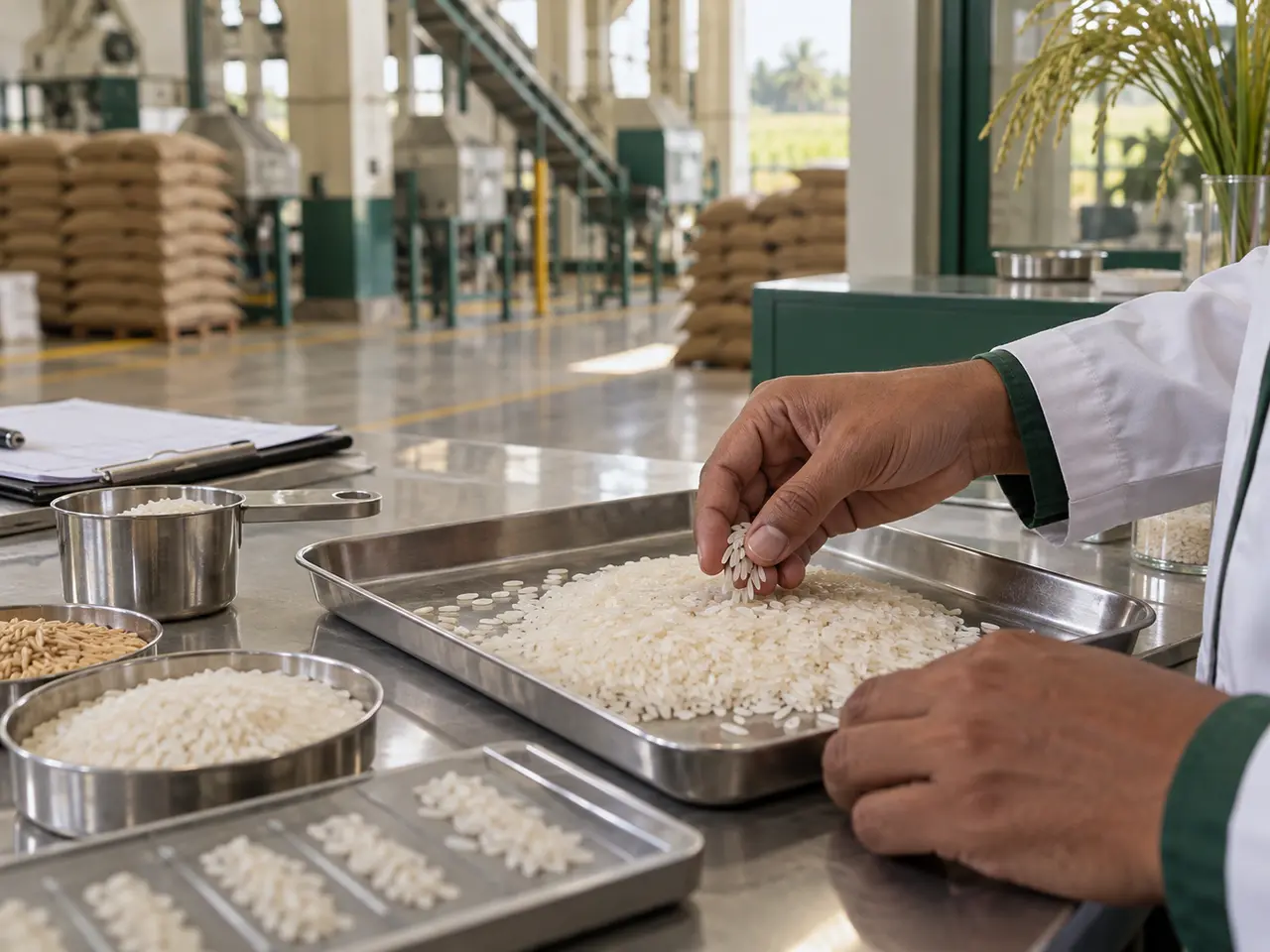
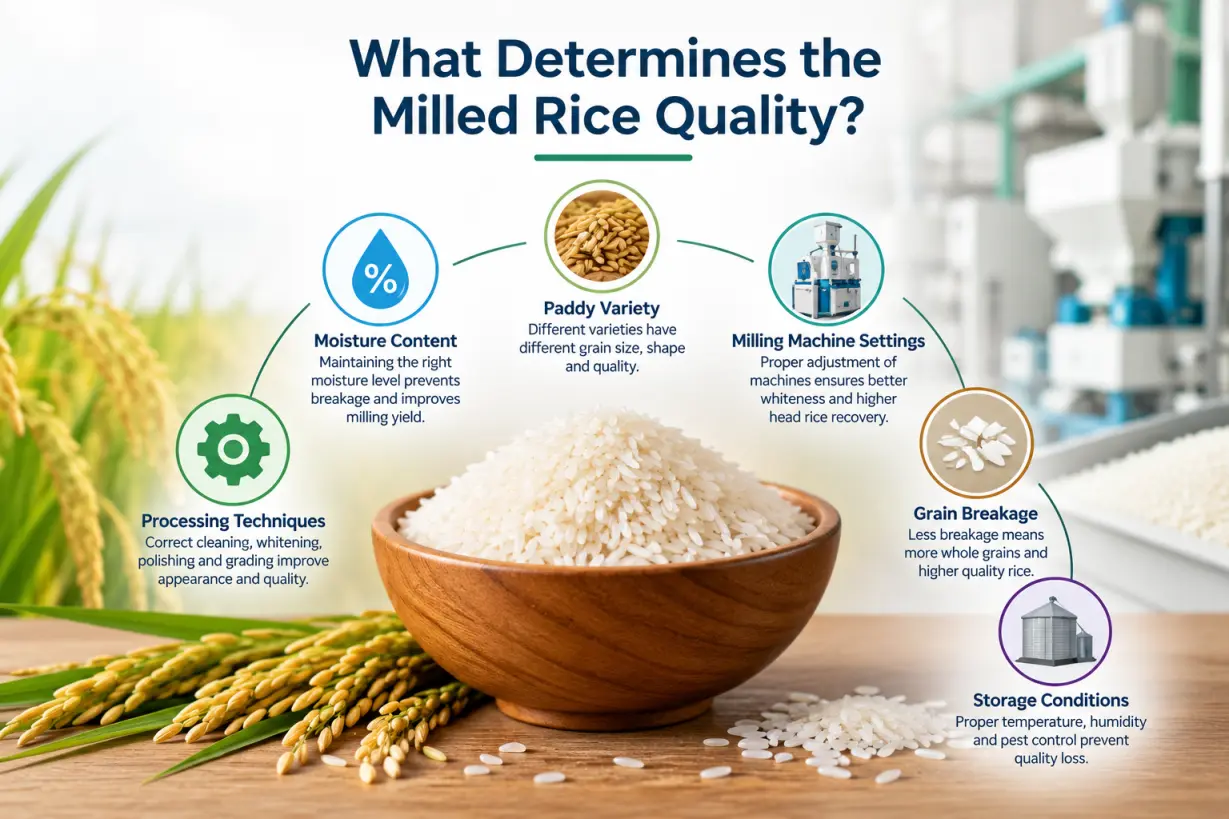
Rice quality is influenced by several factors, starting from the condition of the paddy and continuing through the milling, drying, storage, and handling stages. Even small changes in moisture content, grain characteristics, milling settings, or processing conditions can affect the appearance, texture, yield, and percentage of broken grains in the final product.
Rice Milling Performance Metrics
| Performance Metrix | Target/Reference Range | What it Measures |
|---|---|---|
| Milling Recovery(%) | Approx. 65–72% | Measures the total milled rice recovered from processed paddy. |
| Head Rice Yield(%) | Typically varies by variety and milling system | Measures the proportion of whole or substantially intact rice kernels recovered. |
| Broken Rice(%) | Lower levels are generally preferred | Indicates the amount of rice broken during husking, whitening,polishing and handling |
| Husking Efficiency(%) | Approx. 85–95% | Measures how effectively the husker removes the outer husk. |
| Paddy Moisture Content(% | Approx. 12–14% for milling | Indicates whether paddy has suitable moisture for efficient milling and reduced breakage. |
| Cleaning Efficiency(%) | Typically >95% | Measures the removal of dust, straw, stones and other foreign materials before milling. |
| De-stoning Efficiency (%) | Equipment-dependent | Indicates how effectively stones and heavy impurities are removed |
| Paddy Separation Efficiency(%) | Equipment-dependent | Measures the effectiveness of separating unhusked paddy from brown rice. |
| Rice Whiteness (kett/index) | Product dependent | Measures the visual whiteness and surface appearance of milled rice. |
Rice Milling Performance Parameter:
| Parameter | Value |
|---|---|
| Paddy sample | 100Kg |
| Total milled rice | 68Kg |
| Head rice | 58Kg |
| Broken rice | 10Kg |
| Head Rice Yield | 58% |
What Factors Affect Rice Milling Quality?
The following 12 key factors should be considered when evaluating and maintaining rice milling quality are explained below:
1. Paddy Variety
Different rice varieties have different grain characteristics, including grain length, width, shape, hardness, and resistance to cracking. These characteristics influence how the grain behaves during drying and mechanical processing.
Long-grain and slender varieties may respond differently to milling forces compared with short- or medium-grain varieties.
Important parameters:
- Grain length and width
- Grain shape
- Kernel hardness
- Chalkiness
- Fissured or cracked kernels
- Head rice yield
2. Paddy Moisture Content
Moisture content is one of the most important factors affecting rice milling performance. Paddy that is too wet or too dry can create processing problems.
If paddy is excessively dry, kernels can become more susceptible to cracking and breakage during husking and whitening. If moisture is too high, husk removal and subsequent milling operations may become less efficient.
Important parameters:
- Paddy moisture 12-14%
- Moisture uniformity
- Moisture before milling
- Moisture after drying
3. Paddy Quality and Kernel Condition
The physical condition of the incoming paddy has a direct effect on the quality of milled rice. Paddy containing a high proportion of immature, damaged, discolored, chalky or cracked kernels is more likely to produce lower-quality milled rice.
Pre-existing cracks are particularly important because mechanical forces during milling can cause cracked kernels to break into smaller pieces.
Important parameters:
- Immature grain %
- Damaged grain %
- Cracked/fissured grain %
- Chalky grain %
- Discolored grain %
- Foreign material %
4. Paddy Cleaning
Effective cleaning should take place before the paddy enters the main milling machinery. Paddy can contain dust, straw, stones, soil particles, weed seeds, metal particles and other foreign materials.
Important parameters:
- Cleaning efficiency %
- Foreign material %
- Dust removal
- Straw removal
- Heavy impurity removal
5. De-Stoning Efficiency
Small stones and other heavy particles can enter a rice mill along with harvested paddy. A de-stoner is used to separate these materials before they reach sensitive processing equipment.
Poor de-stoning can allow stones to pass into the milling system, potentially causing equipment damage and creating a product-quality or food-safety concern.
Important parameters:
- Stone removal efficiency
- Quantity of stones entering the mill
- Feed rate
- De-stoner operating condition
6. Drying Conditions
Drying has a major influence on the final milling quality of paddy. Rapid or uneven drying can create differences in moisture and internal stresses within the grain. These stresses can lead to fissures, which may later develop into broken kernels during milling.
Important parameters:
- Final moisture content
- Drying temperature
- Drying rate
- Drying duration
- Moisture uniformity
- Percentage of fissured kernels
7. Storage Conditions
The quality of paddy can change during storage. Temperature, humidity, moisture content, pests, insects, microorganisms and storage duration can influence grain condition.
Poor storage management may lead to deterioration, off-odors, discoloration, insect damage and reduced milling performance.
Proper storage requires control of moisture, temperature, ventilation and pest activity.
Important parameters:
- Grain moisture %
- Storage temperature
- Relative humidity
- Storage duration
- Insect infestation
- Damaged grain %
8. Husking Performance
Husking is the stage where the outer husk is removed from paddy. The husker must remove the husk efficiently without applying unnecessary mechanical stress to the rice kernel.
Rubber-roll huskers are commonly used in modern rice mills because the roll clearance, pressure and feed conditions can be adjusted to control husking performance.
Incorrect roll clearance, excessive pressure, worn rolls or an unsuitable feed rate can increase broken kernels or leave excessive unhusked paddy.
Important parameters:
- Husking efficiency %
- Unhusked paddy %
- Broken rice %
- Rubber-roll condition
- Roll clearance
- Feed rate
9. Paddy Separation
After husking, the material contains a mixture of brown rice and some unhusked paddy. A paddy separator is used to separate these materials.
If separation is poor, unhusked paddy may continue into subsequent milling stages, while brown rice may be unnecessarily returned for additional processing. Both situations can reduce process efficiency.
Important parameters:
- Paddy separation efficiency %
- Unhusked paddy %
- Re-circulation rate
- Brown rice loss
10. Whitening and Degree of Milling
Whitening removes the bran layers from brown rice to produce white rice. The amount of bran removed is commonly described by the degree of milling.
Excessive whitening can remove more material than necessary and may increase broken rice or reduce overall recovery. Insufficient whitening, on the other hand, may result in a product that does not meet the required appearance or market specification.
The correct degree of milling depends on the variety and the desired finished-rice specification.
Important parameters:
- Degree of milling
- Bran removal %
- Rice whiteness
- Broken rice %
- Milling recovery %
11. Polishing Conditions
Polishing is generally used to improve the surface appearance and finish of milled rice. The polishing process must be controlled carefully because excessive mechanical action can increase grain damage.
Polishing conditions such as pressure, residence time and machine condition should be matched to the required product appearance.
Important parameters:
- Rice whiteness
- Surface appearance
- Broken rice %
- Polisher pressure
- Processing time
12. Grading and Separation of Broken Rice
After milling, rice is graded to separate whole kernels from broken kernels and, where required, to classify different kernel sizes.
Effective grading provides a more consistent finished product and allows the mill to quantify head rice and broken-rice fractions.
Important parameters:
- Head Rice Yield %
- Broken Rice %
- Kernel length
- Kernel-size distribution
- Grading efficiency
13. Color Sorting
Color sorters use optical sensors and controlled air ejection to identify and remove kernels that differ from the desired appearance. They can help remove discolored, damaged or other visually defective kernels.
The performance of a color sorter depends on the quality of the incoming rice, machine settings, sensor condition, feed consistency and the type of defect being targeted.
Important parameters:
- Defect removal rate
- Reject rate
- Sorting accuracy
- Feed rate
- Percentage of discolored kernels