Rice milling is the process of converting harvested paddy into edible rice by removing the husk, bran, and other unwanted layers. The process typically involves cleaning, dehusking, whitening, polishing, and grading to produce quality milled rice. Modern rice milling technology helps improve processing efficiency, quality control, and overall milling performance.
Traditional Rice Milling
The main purpose of traditional rice milling is to remove the husk and bran layers from paddy to produce milled rice. Depending on the milling setup, different operations may be performed using separate machines.
How Traditional Rice Milling Works:
A basic traditional rice milling operation generally involves:
Paddy → Cleaning → Dehusking → Husk Separation → Whitening → Grading → Milled Rice
The exact process can vary depending on the equipment and type of rice being processed.Traditional mills often depend more on operator experience. Workers may monitor the machines, adjust operating conditions, inspect the rice, and handle different stages of the process.
Characteristics of Traditional Rice Milling
- Some common characteristics include:
- Relatively simple machinery
- Lower level of automation
- Greater manual involvement
- Lower processing capacity in many small-scale setups
- Limited sorting and grading capabilities
- Greater dependence on operator experience
- Simpler equipment maintenance
- Traditional rice milling can still be suitable where processing requirements are relatively small and investment in advanced equipment is limited.
Advantages of Traditional Rice Milling
- Traditional systems can offer:
- Lower initial investment for some setups
- Simpler machinery
- Easier operation of basic equipment
- Relatively straightforward maintenance
- Suitability for certain small-scale milling operations
- Lower technical requirements for basic systems
Limitations of Traditional Rice Milling
- Some limitations may include:
- Greater dependence on manual labor
- Lower automation
- Limited sorting capabilities
- Less precise process control
- Lower processing capacity in many small-scale systems
- Greater variation in finished product quality
Modern Rice Milling
Modern rice milling uses advanced machinery and rice milling technology to process paddy through a series of controlled and often automated operations.
How Modern Rice Milling Works
A typical modern rice milling process may follow this sequence:
Paddy Reception → Cleaning → Destoning → Dehusking → Paddy Separation → Whitening → Polishing → Grading → Color Sorting → Packaging
The exact configuration depends on the mill's capacity, rice variety, product requirements, and equipment manufacturer.
Key Features of Modern Rice Milling
Modern rice milling commonly includes:
- Automated processing systems
- Advanced rice milling machines
- Improved dehusking and separation systems
- Rice whitening and polishing equipment
- Mechanical grading
- Optical or color sorting
- Automated material handling
- Improved process monitoring
- Integrated by-product collection
The purpose of modern rice milling technology is not simply to increase automation. It also helps mill operators achieve more controlled and consistent processing.
Advantages of Modern Rice Milling
Modern rice milling technology provides several capabilities, including:
- Higher processing capacity
- Greater automation
- Improved process control
- Better separation of paddy and rice
- Advanced grading and sorting
- More consistent product quality
- Reduced manual intervention
- Improved handling of rice milling by-products
- Integration of multiple processing stages
Limitations of Modern Rice Milling
Modern milling systems can also present challenges:
- Higher Initial Investment: Advanced machinery and automation generally require greater capital investment.
- Skilled Workforce: Modern equipment requires trained personnel for operation, maintenance, and quality control.
- Maintenance Requirements: Automated systems contain more components and require regular inspection and maintenance.
- Energy Requirements: Energy consumption depends on the equipment, plant capacity, operating conditions, and overall mill design.
Advantages and Limitations
Both traditional and modern rice milling systems have their own advantages and limitations. The appropriate choice depends on the scale and requirements of the milling operation
Traditional vs Modern Rice Milling: Key Differences
Traditional and modern rice milling differ mainly in their technology, automation, machinery, processing capacity, labor requirements, and quality-control capabilities.
| What Changes | Traditional Milling | Modern Milling |
|---|---|---|
| Technology | Basic or conventional | Advanced |
| Process control | More Operator dependent | More controlled and automated |
| Manual involvement | Higher | Lower |
| Processing capacity | Generally Lower | Generally Higher |
| sorting | Basic | Advanced Grading and sorting |
| Quality consistency | Can vary | More consistent when properly operated |
| Machinery | Simpler equipment | Integrated milling machinery |
| Labor | More manual work | More technical and supervisory roles |
| Investment | Generally low | High |
| Maintenance | Simple basic systems | More technical and supervisory roles |
| By Product Handling | Basic systems | More integrated systems |
Technology and Automation
The most noticeable difference is the level of technology used.
- Traditional rice milling generally relies on basic mechanical equipment, whereas modern systems use advanced rice milling technology to automate and control several processing stages.
- Automation can reduce repetitive manual work and help maintain more consistent operating conditions.
Processing Capacity
- Traditional mills are often used for smaller-scale processing, although capacity varies according to the equipment.
- Modern rice mills are designed to process larger quantities of paddy through continuous processing lines.
Labor Requirements
- Traditional milling may require more workers to monitor and handle different stages.
- Modern mills reduce manual intervention through automation, but they still require skilled personnel for machine operation, maintenance, quality control, and process management.
Rice Quality
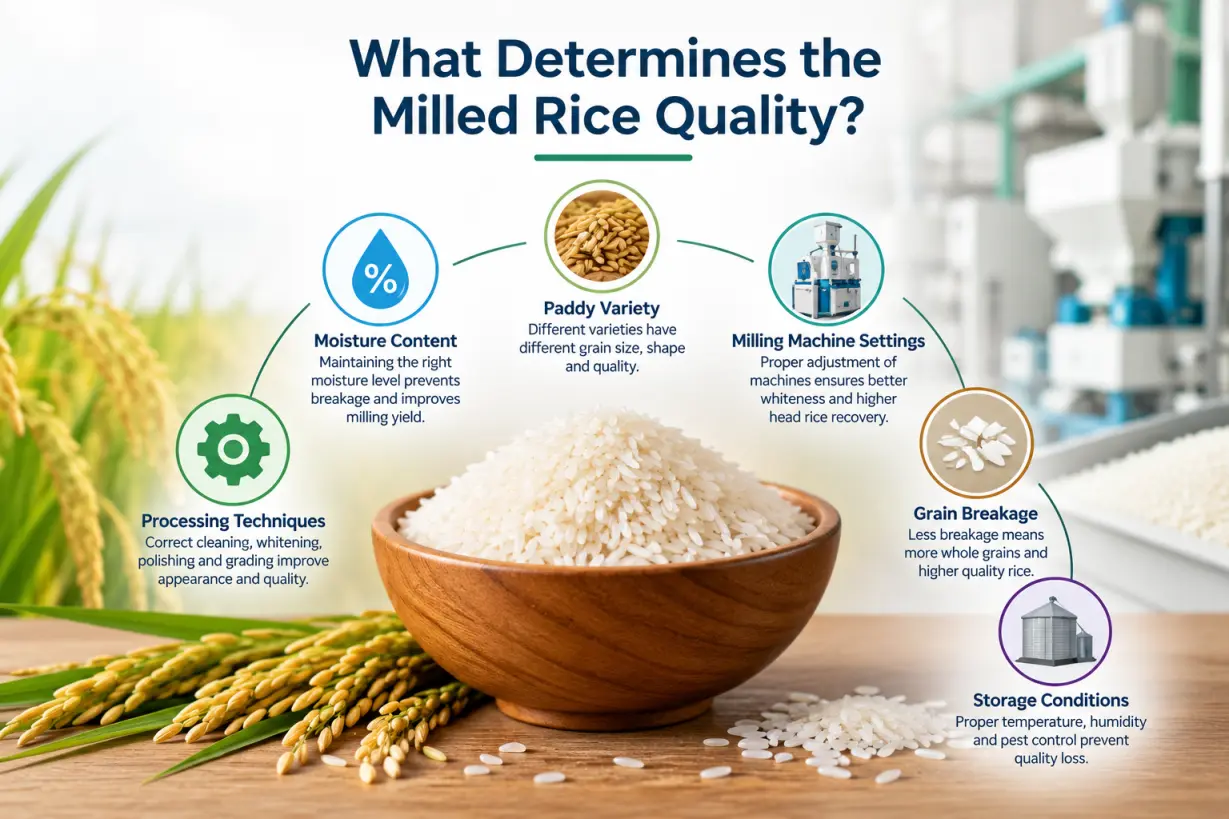
- Rice quality depends on many factors, including paddy variety, moisture content, drying conditions, machine settings, and handling.
- Modern equipment provides greater control over several milling stages and can include advanced grading and sorting systems. This can help achieve more consistent output when the process is correctly managed.
Milling Yield and Broken Rice
- Milling yield and broken rice percentage are important indicators of milling performance.
- Modern milling equipment can provide improved control over dehusking, whitening, polishing, and grain handling. Proper machine adjustment can help reduce unnecessary grain breakage.
Frequently Asked Questions
Does modern rice milling improve rice quality?
Modern equipment can provide greater control over several milling stages and can support more consistent grading and sorting. However, final rice quality also depends on paddy quality, moisture content, machine settings, and proper process management.
Does modern rice milling reduce broken rice?
Modern milling equipment can help reduce unnecessary grain breakage through improved processing and control. However, broken rice levels depend on several factors, including paddy variety, moisture content, machine settings, and handling.
Why is automation important in modern rice milling?
Automation helps improve process consistency, reduce manual intervention, monitor operating conditions, and maintain more uniform processing.
How can consumers identify good-quality rice?
Consumers can examine characteristics such as grain uniformity, cleanliness, appearance, broken-grain content, odor, and the presence of damaged or discolored grains.
Why is moisture important in stored rice?
Moisture affects the stability and storage condition of rice. Proper moisture management helps reduce the risk of spoilage and quality deterioration.
Conclusion
Traditional and modern rice milling use the same fundamental objective: converting paddy into high-quality milled rice. However, they differ considerably in technology, automation, machinery, processing capacity, labor requirements, and quality-control capabilities. The right milling system ultimately depends on factors such as processing volume, investment, product requirements, available infrastructure, labor, and maintenance capabilities.